Language model for DOS that fits on a floppy disk
- License
- MIT
- Stars
- 399
- Try it
Copy the dos folder to the DOS machine, then: CD \TINY and TINY
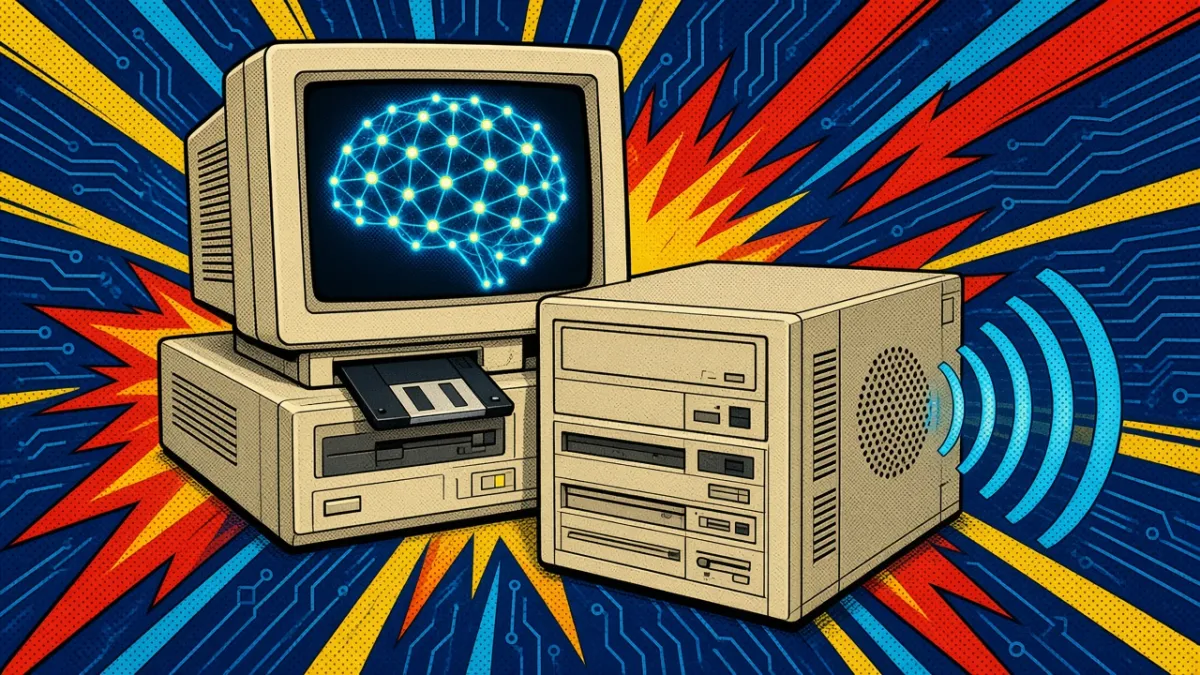
A developer has fit a working transformer language model on a single 1.44 MB floppy disk that runs under plain MS-DOS on 486 and Pentium PCs. Tiny 2.1 is a 367,000-parameter question-answering model. Its program is written in Turbo C 2.0, and it reads its answers aloud through the PC speaker. GitHub's search API shows the repo, WollyMonjac/Tiny-2.1, was created on November 15. By early November 23 it had 399 stars and 55 forks. Notebookcheck covered it on November 22.
Why it's interesting: it's a real, inspectable example of how far a language model can be shrunk and still do something useful. It's also an example of AI-built software. The README says the code was written by Claude Fable 5.2 and the model was trained by Claude Opus 5.5.
What's in the repo
According to the README and Notebookcheck:
| Spec | Tiny 2.1 |
|---|---|
| Parameters | ~367,000 |
| Architecture | 4 layers, width 96, character-by-character |
| Weights | 8-bit, one scale per row, ~380 KB |
| Package size | ~435 KB (fits a 1.44 MB floppy, per Notebookcheck) |
| Memory needed | ~540 KB free conventional memory |
| CPU | 486DX or Pentium, plain DOS |
| Inference code | Turbo C 2.0 (TCC -ml TINY.C to rebuild) |
| Training code | Python 3, NumPy, PyTorch |
| Output | Full-screen text UI plus robotic speech via the PC speaker |
The interface is more elaborate than you'd expect from 435 KB. Notebookcheck and the README describe a full-screen layout with a live "neural monitor", conversation history and F-key shortcuts.
How it was made
The README says Tiny was trained on about 3,500 facts, each phrased many different ways. The facts and question variants were generated with Claude Opus 5.5, according to Notebookcheck and the README. The training kit is in the repo's training folder: a fact list, a generator script (gen2.py) and a PyTorch training script (train2.py). The README says an ordinary CPU is enough to train it.
The DEV Community write-up, which reposts Tom's Hardware's coverage, gives accuracy figures it attributes to the README: about 90% on phrasings it was trained on and about 61% on 780 unseen test questions, compared with 6% for the first version. We couldn't find those numbers in the part of the README we read, so treat them as reported. The same write-up says a math coprocessor makes the difference between an answer in a few seconds and one that takes several minutes under software emulation. No source we read names a specific test machine.
Limits
- It's a fact recaller, not a chatbot. The README is upfront that Tiny makes things up for anything outside its training facts and struggles with complex or long questions. The DEV write-up says its documented weak spots include questions comparing two countries, rare chemical elements, division and larger arithmetic.
- Not all of it is MIT. The code is MIT-licensed. The README says three training data files derived from public datasets keep their own ODbL and CC BY-SA licences, listed in
DATA_LICENSES.md. Notebookcheck's description of the training scripts as MIT doesn't mention that distinction. - Anonymous author. None of the sources names the developer behind the WollyMonjac account.
How to try it
On real hardware, the README says to copy the dos folder to the machine and run CD \TINY then TINY, keeping TINY.EXE and TINY.BIN in the same folder. Key bindings are in dos/README.TXT. Without a vintage PC, Notebookcheck suggests downloading the ZIP and running it in an MS-DOS emulator.
Who should care: retro-computing hobbyists will want to try it. So will anyone teaching how transformers work: the whole inference path is one small C program you can actually read, and the training kit runs on a laptop.