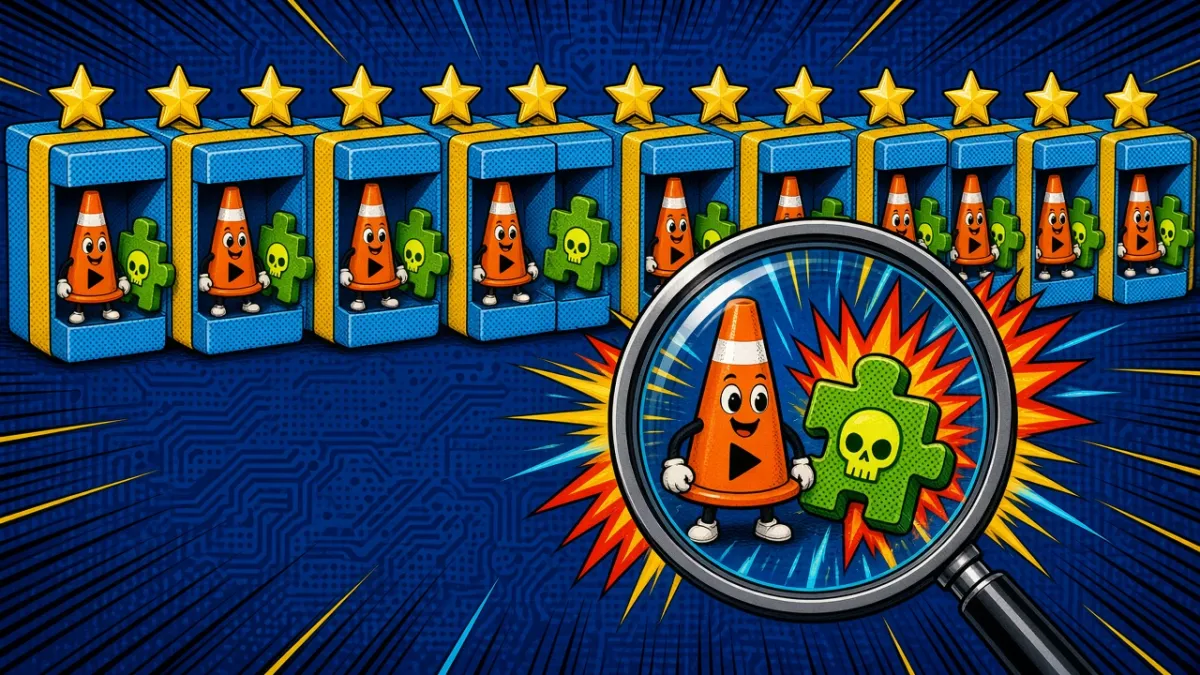
Fourteen GitHub repositories that each claim to be a free, open-source Windows utility all ship the same download. The list includes a PDF editor, a clipboard manager, a Git client, a KVM tool, a fan controller and a video downloader. All were created in a 30-minute window on November 27 (15:09–15:39 UTC), and each had between about 1,100 and 1,800 stars by 01:00 UTC on November 29, according to GitHub's search API. That puts them at the top of a GitHub search for new repositories sorted by stars. Thirteen had no forks at all, and the fourteenth had one.
We cloned all 14 and inspected the files without running anything. Every repo contains the same ZIP archive (SHA-256 3e48b042…0c6c11), byte for byte. It holds just two files: a signed VLC media player executable renamed latest.exe and an unsigned libvlc.dll. That pairing is a known DLL side-loading setup. A trusted program is placed in the same folder as a malicious DLL, and when the program starts, Windows loads the DLL and runs its code.
Why this matters
These repos sit at the top of GitHub's star rankings, the kind of ranking that trend trackers and newsletters use to surface new tools. A thousand stars appearing in hours, with zero forks and no real commit history, is the pattern researchers call fake stars. Every README tells readers to download a ZIP from the repo's Releases page, not to build from source.
What we found in the repos
| Signal | What we saw |
|---|---|
| Creation time | All 14 created Nov 27, 15:09–15:39 UTC, by 14 different accounts |
| History | 2–9 commits each. Besides "Initial commit", they are boilerplate files (code of conduct, PR template, dependabot config) whose author fields claim to be bots like coderabbitai[bot], dependabot-preview[bot] and chatgpt-codex-connector[bot]. In every repo, all commits are timestamped within three seconds of each other. Git author fields can be set to anything, so these entries prove nothing. |
| Download | The same ZIP in all 14 repos (14 of 14 hashes match). In 13 repos, latest.exe and libvlc.dll are also committed loose in the repo root. |
latest.exe |
x86-64 PE whose version info says VLC media player 3.0.24 (vlc.exe), with a signature block naming VideoLAN. It imports seven functions from libvlc.dll. |
libvlc.dll |
Unsigned, about 2.1 MB, build timestamp Nov 26 16:05 UTC. It exports only DllMain plus the seven functions that vlc.exe calls. Its imports include CreateProcessW, VirtualProtect, CreateToolhelp32Snapshot, SuspendThread, MoveFileExW and SetFileTime. |
| Source code | Each repo includes a plausible-looking app project, in languages ranging from C# and C++ to Python and Haskell. None of that code is in the shipped ZIP, which holds only the two binaries. |
What we did not do: we did not execute the binaries or detonate them in a sandbox, and we found no antivirus verdict or published researcher analysis of these exact files. Searches for both executable hashes turned up nothing. Function names are a static hint, not proof, so we are not saying what the DLL does. We are saying the package has the structure of a side-loading lure: a PDF editor, a fan controller and a Git client have no reason to ship the same VLC player and a stub libvlc.dll.
This exact trick has been used before
- CrowdStrike says that from late 2022 it saw ransomware intrusions against the health sector in which a copy of
vlc.exe, renamed to look like a Windows component, loaded a maliciouslibvlc.dllcarrying a Cobalt Strike payload. It calls side-loading "one of the most prevalent techniques amongst attackers." - In July 2026, Cyber Security News reported LevelBlue research on phishing ZIPs pairing a genuine VLC build with a malicious
libvlc.dllto install the ValleyRAT remote-access trojan. - GitHub lures at scale aren't new: BreachNews, summarizing Socket's research, described 222 fake repos across 190 accounts in July, and GBHackers reported in November that Doctor Web tied fake GitHub "security tools" to more than 2,000 infected computers. We found nothing linking this cluster to those campaigns.
The 14 repositories
Names as they appear on GitHub. We are deliberately not linking them.
Leaf82770/windows-mica-backdrop-customizer, quartzdev666/windows-pdf-editor, Codelab781/windows-clipboard-sync-manager, hollow-445/windows-keyboard-manager, Quill400/windows-image-viewer, riveran0226/windows-explorer-blur-mica, mist-8659/windows-mouse-keyboard-sharing-kvm, flint63-code/gitdesk-windows, nocta1554/windows-video-downloader-gui, Loris-593/notebook-fan-control-windows, Riven-639/windows-dwm-blur-glass-customizer, Ash793318/windows-hardware-monitor, leaf7684/windows-modern-media-player, Red2076-arch/waifu2x-image-upscaler-windows
File hashes (SHA-256):
latest.exe   63d0d02df6e466d642b824dc66be6b5a134bf98b26747ffac8ec0d879dc180d7
libvlc.dll   a55aba415647b15987d7de2b2f0e8b4da53cb0d3ca6878a4284fb437ce9b3084
*.zip        3e48b04233060c230d1ff80d35bd23561d01ad6381a061cf54da7f41aa0c6c11
What to do
These are our recommendations. No vendor has issued guidance on this cluster.
- If you downloaded one of these ZIPs and haven't opened it, delete it.
- If you ran
latest.exe, treat the PC as compromised. Disconnect it, run a full scan with an up-to-date security product, and from a different device change the passwords for anything you were signed into on it: browser-saved logins, email, GitHub, crypto wallets. Check for new scheduled tasks or startup entries. Wiping and reinstalling is the safe option. - Defenders: add the hashes above to blocklists. Alert when
libvlc.dllloads from outsideC:\Program Files\VideoLAN\VLCorC:\Program Files (x86)\VideoLAN\VLC. That is the logic of a published ManageEngine detection rule. - Everyone: don't trust a star count on a repo that's a day old. Zero forks, burst-created sibling repos and a "download the ZIP" README that ignores the source code are all red flags. For the real tools these repos imitate, use the original projects' official sites.
- Report them: each repo page has a "Report repository" option for malware or abuse.
We'll update this story if GitHub removes the repos or a security vendor publishes an analysis of the DLL.
Sources
- CrowdStrike — DLL Side-Loading: How to Combat Threat Actor Evasion Techniques crowdstrike.com
- Cyber Security News — Hackers Use Fake VLC Executable and Malicious libvlc.dll to Deploy ValleyRAT cybersecuritynews.com
- ManageEngine Log360 — Potential Libvlc.DLL Sideloading (detection rule) manageengine.com
- BreachNews — Researchers Uncover 222 Fake GitHub Repositories Used to Spread Windows Malware breachnews.com
- GBHackers — Hackers Use Fake GitHub Security Tools to Spread Malware, Infecting Over 2,000 Computers gbhackers.com